
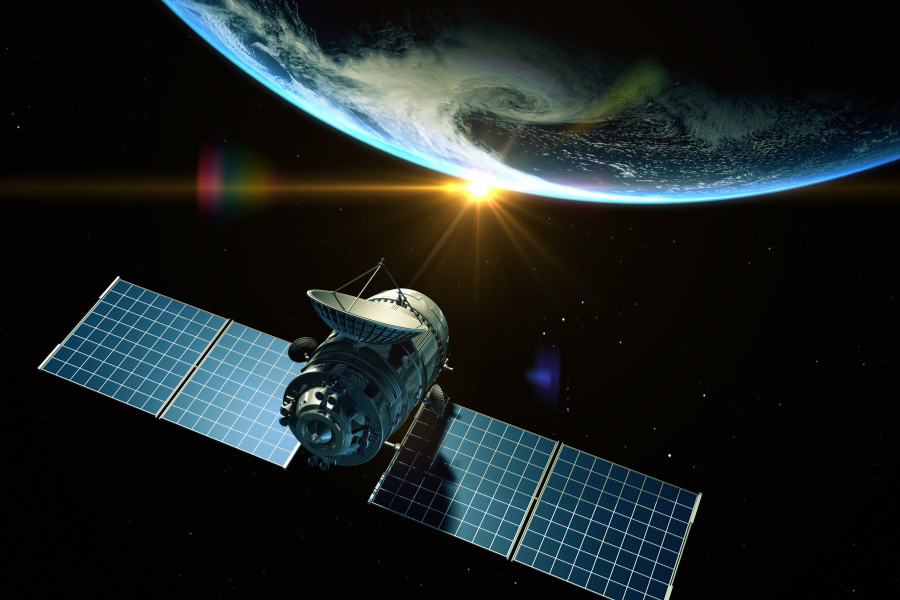
Mining was always about what lay under the ground. But today, the most transformative force in mining is up above hundreds of kilometres up above. Efficiency, sustainability and resilience have moved from optional to essential in the industry’s Mining 4.0 era. The sector has an increasingly delicate three-way tightrope to walk, between catering for growing global demand, environmental stewardship, and fulfilling its regulator obligations.
This balancing act demands tools that can see more, forecast better and run faster. Add satellite technology mining and smart mining data analytics into the picture. Through radar, infrared and optical satellite imagery mining, companies are beginning to see their operations like never before, with predictive mining analytics allowing for safer extraction methods alongside a more transparent reporting process.
Today on the blog, we dive into how satellite intelligence is the next frontier of smart mining, an industry where resource development is driven not only by trucks and drills, but rather by mining data analytics from space.
Why is Satellite Technology for Mining 4.0 Necessary?
The term Mining 4.0 refers to digitalization, automation and analytics. A critical enabler in that transformation is satellite-delivered:
- Remote sensing mining over inaccessible and dangerous terrain.
- Continuous, rather than costly and time-delayed manual inspections.
- Sensory fusion (radar imagery for mining, infrared, and optical) for a full battle picture.
- Predictive mining analytics that can predict your risk, maximize your productivity and guide rehabilitation.
Satellites, in contrast to traditional ground-based surveys or aerial monitoring, offer a macro perspective on mining landscapes that expose patterns and risks inherently invisible from the ground. This is not just about efficiency; rather it is about creating a future-ready mining sector that can prosper under scrutiny and amidst global expectations that continue to change.
Radar Imagery – Precision Beyond Weather and Darkness
One of the most powerful tools available today for mineral exploration is radar imagery for mining. When compared to optical satellites, radars are also weather-independent and can operate in total darkness, a major advantage for sites where operations are not feasible during day and night due to either cloud cover or lack of visibility.
Applications of Radar Imagery in Mining
- Ground monitoring – Identifying subsidence, landslides or slope movements which endanger miners and/or assets.
- Tailings dam surveillance – Detecting early signs of structural weakness to avoid catastrophic accidents.
- Operational mapping – Monitoring pits, haul roads and waste accumulations at a centimetric scale.
Value to Mining Companies
- Reduces the need for manpower in manual surveys.
- Supports compliance reporting with continuous data.
- Enhances risk management; saves lives as well as dollars.
Infrared Imaging – Seeing the Invisible
Infrared imaging mining operations provide insights that are not humanly perceivable but capture subtle variations in temperature and vegetation health.
Applications of Thermography in Mining
- Re-vegetation and rehabilitation monitoring – Detecting vegetation stress.
- Thermal anomaly detection – Identifying underground fires, chemical leaks, or overheating equipment before emergencies.
- Water monitoring – Spotting temperature changes in rivers or reservoirs that signal pollution or environmental stress.
Value to Mining Companies
- Delivers verifiable compliance evidence.
- Shows regulators and communities proactive stewardship.
- Enables sustainable operations by mitigating risks early.
Optical Satellite Imagery – Visual Proof for Operations
Optical satellite imagery mining provides high-resolution photographs familiar to most people. These crisp images have operational and strategic uses.
Applications of Optical Imagery in Mining
- Site mapping – Precise, up-to-date mine maps.
- Monitoring land-cover change – Detecting deforestation and new infrastructure.
- Stakeholder communication – Offering regulators and investors visual evidence.
Value to Mining Companies
- Increases transparency through auditable data.
- Builds investor trust with accountability.
- Complements radar and infrared, creating a full monitoring toolkit.
Smart Data and Predictive Mining Analytics
The raw imagery from satellites becomes valuable only when paired with mining data analytics. Predictive mining analytics converts data into intelligence that enables proactive planning.
Key Predictive Applications
- Production prediction – Quantifying stockpile and ore movement.
- Risk mitigation – Identifying early warnings of instability or tailings stress.
- Recovery planning – Linking time-series forecasting with long-term ecosystem restoration.
Business Impact
- Turns unprocessed data into actionable intelligence.
- Supports data-driven exploration, operations, and closure.
- Ensures continuous optimization of performance.
Integrating Satellite Technology into Mining Growth Strategies
Smart mining won’t reach its full potential unless satellite insights are integrated into growth strategies. This includes:
- Reconnaissance – Pre-locating mineral-rich areas.
- Operations – Real-time safety and asset monitoring.
- Sustainability – Demonstrating compliance with UN SDGs and IFC standards.
- Growth – Expanding with scalable, predictive insights.
Global Regulations and Frameworks Driving Adoption
Mining today is tightly regulated. Remote sensing mining and satellite-enabled monitoring help address:
- Environmental laws – Detecting deforestation and water pollution.
- ESG frameworks – Aligning with GRI, IFC, and investor standards.
- Local requirements – Meeting stricter monitoring laws in Australia, Canada, and the EU.
The Business Value of Satellite-Driven Mining 4.0
When satellite technology mining and smart data converge, value multiplies:
- Savings – Reduces downtime and costs.
- Safety – Lowers accident risks.
- Predictive – Strengthens supply chains with forecasting.
- Transparency – Builds stakeholder trust.
- Resilience – Improves adaptability to markets and regulations.
Conclusion – The Future of Mining is Orbiting Above
Mining is transforming, and those who want to stay ahead in Mining 4.0 will embrace satellite technology mining and predictive mining analytics. Using radar imagery for mining, infrared imaging mining operations, and optical satellite imagery mining, companies can increase efficiency, safety, and sustainability.
This is not just a technical upgrade but a new paradigm in smart mining. By combining remote sensing mining with mining data analytics, the sector can build resilient, transparent, and future-ready operations.
The mines of tomorrow will belong to those who look upward, using space-based intelligence to power safer, smarter, and greener mining. Envision Beyond empowers mining companies to harness these technologies with precision, transforming satellite data into actionable insights that drive growth while protecting the planet.